-
From the Archives: Bruichladdich The Classic Laddie Review (2019)
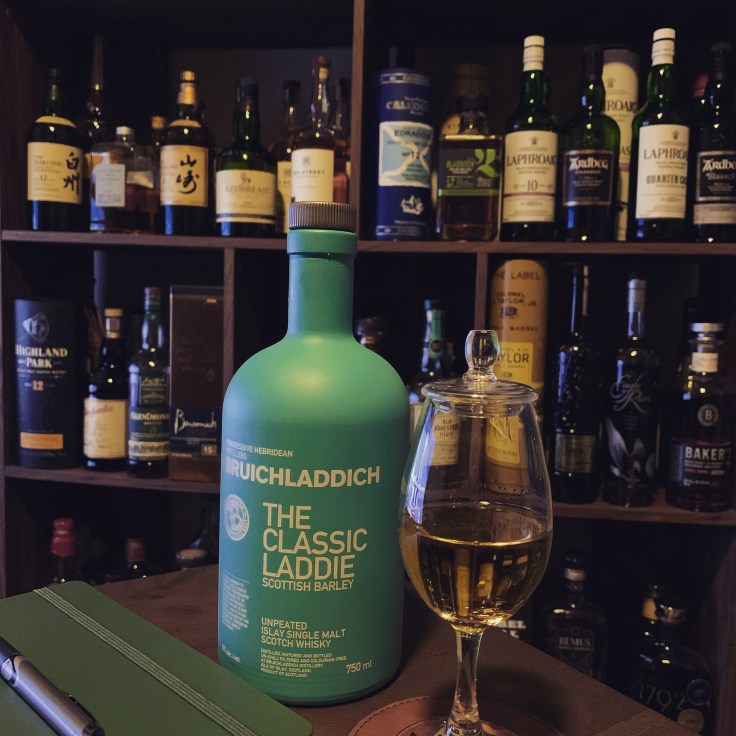
Bruichladdich The Classic Laddie (2019)
Strength: 50% ABV
Purchased: 2020 – ~$60 + tax
Bottled: 6/6/2019 (Bottle Code: 19/124)
Aged: 7 to 8 years (per Buichladdich’s website)
Casks: Ex-Bourbon, French Red Wine Barrels, Spanish Ribeira barrels.
Presentation: Non-chill filtered, Natural Color
Original Review: November 15, 2020
Score: 6. Above Average.
From the Archives: FTA is a series of tasting notes and reviews that I had hand written earlier on in my whisky journey. These notes may not reflect how I would feel today, but represent my attempts to begin verbalizing what I was experiencing. I chose to hand write these because that seemed like a more intimate and focused effort. It also made me slow down a bit to think, write, and shake off any writing cramps between sips. In the spirit of full disclosure, I did add some text to make the reading experience a bit easier. I hope these ‘reviews’ will provide some context in my journey and will provide some reference points for my evolving palate over time.
The Review
Details: Bottle was ⅕ full at time of review. Bottle code for reference on www.bruichladdich.com was 19/124.
Nose: Vanilla, Lemon, Pie crust. Fresh and Floral.
Palate: Salty, tart, and peppery in that order of magnitude. A malty sweetness was present throughout.
Finish: Long finish, warming, with lingering pepper and barley sugar.
With Water: More fruitiness comes forward on the nose. The salinity dies down quite a bit on the palate and finish.
In Retrospect: Looking back on these notes I can tell that I was struggling to identify individual flavors here. It looks like I was more focused on the sensation range than actual flavor notes and that makes sense as I feel that the sensations are significantly easier to identify than putting names to flavors. Generally speaking, I have been a big fan of Bruichladdich and their various offerings over the years and I definitely feel like this bottle got the short end of the stick when it comes to my newbie attempts at analytics. I rated this one in my notes an 8.0 out of 10 which was a decent score compared to other ratings I gave at the time, a score which belies the sparse and somewhat bland notes I gave. I did have another bottle of this waiting to be opened, but it mysteriously disappeared in a cross country move. It remains a mystery that I have yet to let go of and will randomly dig through boxes and closets to see if it somehow made its way into a forgotten corner somewhere. Knowing that “I have a bottle here somewhere” has stopped me from buying another, but it may be time to give in.
Of course, the missing bottle will reappear as soon as I walk in the door with a new one…
I am going to give this one a 6/10 as I do know that I appreciated the extra points of ABV and overall presentation, and I have to respect the 8/10 score I gave it on my old system. Score: 6/10. Above Average.
-
From the Archives: Compass Box Spice Tree (2020) Review
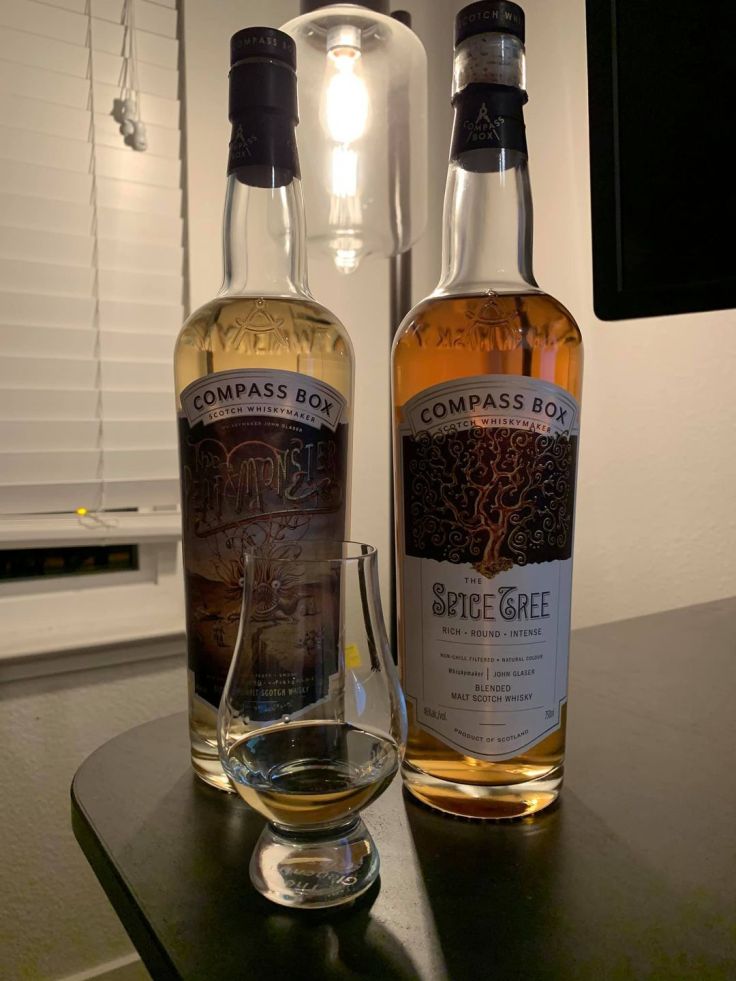
Compass Box Spice Tree (2020) Review
Strength: 46% ABV
Purchased: Early 2020 in the U.S. (CA)
Price: $60 + tax
Age/Casks: Blend. Details from Compass Box
Date of Review: November 14 2020
Score: 6. Above Average. Skip to the Review
From the Archives: FTA is a series of tasting notes and reviews that I had hand written earlier on in my whisky journey. These notes may not reflect how I would feel today, but represent my attempts to begin verbalizing what I was experiencing. I chose to hand write these because that seemed like a more intimate and focused effort. It also made me slow down a bit to think, write, and shake off any writing cramps between sips. In the spirit of full disclosure, I did add some text to make the reading experience a bit easier. I hope these ‘reviews’ will provide some context in my journey and will provide some reference points for my evolving palate over time.
The Review
Details: Bottle was ⅕ full at review time. Open for less than 1 year.
Nose: Malted vanilla ice cream, green apples, ginger
Palate: Cotton candy up front and darkens in sweetness into a surprisingly salty caramel. Then comes the promised spices of clove and cinnamon.
Finish: The spiciness lingers with a gentle warmness. A hint of black pepper emerges. Medium long finish that coats the mouth.
With Water: Initially the nose turns more spike-y with a good amount of white pepper. Eventually, it settles and a honey note accompanies the original vanilla. Some sultanas emerge as well. The palate is fresh and bright, moving away from the initial sweetness of the neat dram into something more crisp and refreshing, a la lemon lime soda. There is less of a journey to be had here, but the experience becomes more cohesive overall, showcasing an effervescent citric but malt forward sweetness with a dash of ginger. Some caramel remains but the salt is less obvious. The finish feels like it suffered the most, with a noticeable drop in intensity, but it still manages to stick around for a while.
Overall: I recall that when I first purchased this bottle I was very early on in my whisky journey, and upon first taste I was amazed at “how much was going on.” Funnily enough, I remember posting that exact line on a local whisky Facebook group, and this was probably one of the first times I ever posted an “opinion” publicly. By the time I reviewed and finished that bottle later the same year, I recall still thoroughly enjoying it, although the wonderment had probably worn off a bit. It does seem to be a whisky that was an excellent option for my first attempts at truly putting together some tasting notes on paper, as I felt it was fairly easy to read even then. In my notes, I rated this whisky an 8.5/10 and noted I thought it to be a high value bottle. I believe if I were to rescore this using my contemporary system, this whisky would receive a 6/10 and would be considered a fair value. Unfortunately, this was before I started saving a sample from my bottles so I do not currently have any to re-review at this time. Score: 6/10. Above Average.
-
Review: Ardbeg 10 (2020) – Sinking Ship or Nostalgia Trip?
*Guest blog*
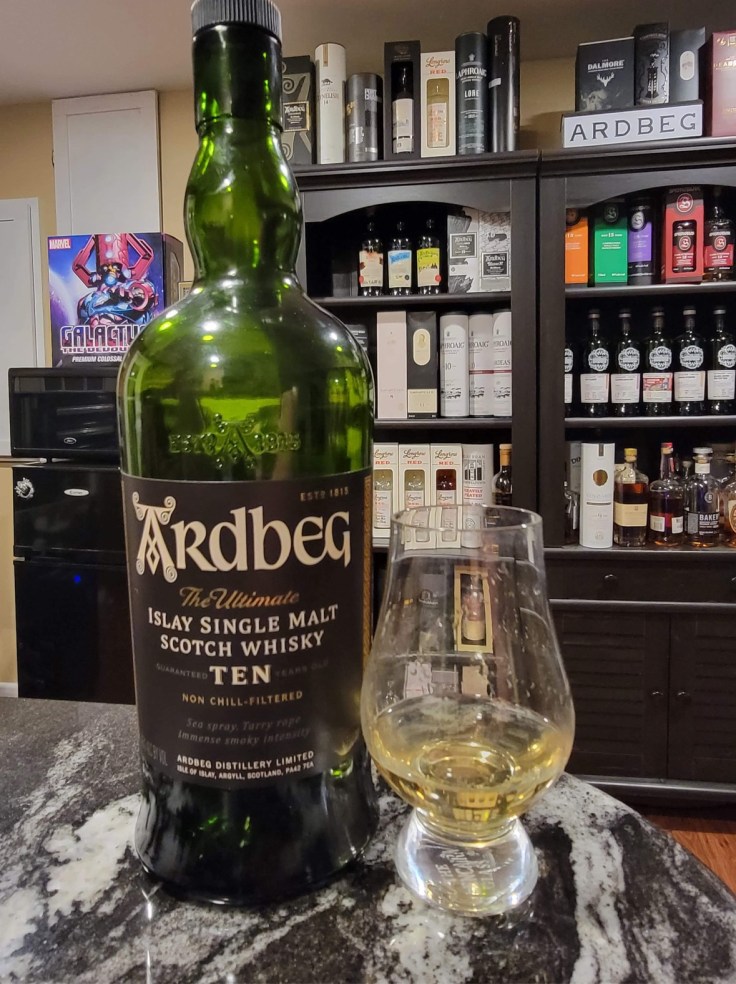
Ardbeg 10 (09.26.2020)
46% ABV
Purchased: 2021
Price: $55 + tax
Aged: Ex-Bourbon
Qualifications: Non-Chill Filtered and No Color Added
Score: 6. Above Average. Skip to the Review
First, an Introduction
Before we get started, I should probably bring it to your attention that I am not, in fact, Whisky Against Humanity. He has graciously given me the privilege of writing up this whisky review and posting here. He is currently in the process of moving to a different state, so I thought I would fill in and give my thoughts until he gets resettled in his new space. And who knows, maybe I’ll continue to throw in my two
cents every now and again…My handle is WhiskytheGathering, and I am Whisky Against Humanity’s brother. I am relatively early in my whisky journey (2-3 years), but have been feverishly consuming whisky content on the internet (and perhaps the whisky itself, safely and responsibly, of course!). I am an avid fan of many YouTube channels and blogs and have been thinking of branching into that space for myself. Whisky Against Humanity and I do a blind whisky lineup for each other every other week, where we both get to try things that we do not own, and truly put our palates, noses, and preferences to the test. Blind tastings are one of my favorite things to do in the whisky world. But I think I’ll save any additional details about those experiences for another time. Let’s get to the musings already, shall we?
Actually…. no, not yet. Sorry.
For you to understand where I’m coming from, some additional context may be helpful. My first “Oh, wow” whisky moment that I recall, was a peated scotch. Specifically, it was Ardbeg UigeadaiI. It was bold, fruity, ashy, and wow was it good. It really opened my eyes to what this stuff could be, and very likely was the hook I needed to take the dive myself into scotch. From there, Ardbeg became my flagship. I picked up my own Uigeadail and a Corryvreckan. And since then, I have picked up every committee release as it’s come out, Traigh Bhan Batch 1, several other bottles and even shelled out for a committee bottling of Dark Cove and an Ardbeg 21. It’s safe to say that I’m a fan. I’ve certainly come to love and appreciate all types of whiskies, but Ardbeg has a soft spot in my heart. Ok, now let’s muse.
Sinking Ship or Nostalgia Trip?
I have heard it all regarding Ardbeg. Rants from the “Cult of Ardbeg” defending what they believe is the greatest distillery on earth, to the naysayers parading that Ardbeg has lost its way. For the latter, the reasons include the quality of its products, the prices and/or its marketing. I do not believe there is currently a more divisive distillery in scotch whisky. I’d like to point out that I am not here to defend either side, and I am largely just thinking out loud. As with most things, the answer is somewhere in the middle.
I think it’s clear that Ardbeg has taken a unique approach as a distillery. It certainly isn’t presenting itself as a distillery that is quite as steeped in tradition and elegance as most others do. It has definitely placed a more modern take and approach to most of its offerings. Between releasing whiskies named Ardcore and Fermutation, to selling NFT tickets, to burying whisky barrels in a peat bog to age them, to publishing their own comic book line, it can certainly be a kind of culture shock to a typical scotch drinker. All these things, along with the perceived decline in quality and rising prices, make Ardbeg an easy distillery to grumble about.
I want to specifically focus on the quality aspect though. Regarding the gimmicks, each person’s mileage will vary. You’ll love it, hate it, or be indifferent, but that’s not what matters though, is it? The only thing that really matters is, “How good is the whisky in the bottle?”
To be clear, I don’t doubt that the quality has in fact declined in recent years. I have heard many, many times that the 10 year isn’t what it used to be, and while I haven’t had any old Ardbeg 10 bottlings, I’ll take their word for it and believe them. What I do not believe, is that this is solely due to cutting corners, penny pinching, or generally pessimistic decisions on the part of Ardbeg. There are tough decisions that have needed to be made the last few years. The scotch whisky boom over the last decade has undoubtedly put pressure on the available filled casks. To keep product available, many distilleries have been pressured to release more product than they initially planned when the spirit was distilled. Which means their available stock gets spread a little bit thinner as they continue to release product to meet demand until they can catch back up again, which as we know, takes years. It’s not unrealistic to think that the 10 year old might have had some older stock in it, and they just don’t have the same proportions of stock to make it the way they once did, solely due to the fact that they want their product to be available to the average consumer.
One could also argue that they don’t need to increase production. They could continue the course, making the “better” whisky, in less volume than current demand. Meanwhile, their batches would sell out immediately, making it unattainable to most people, ala Springbank. This would cost them quite a lot of money in missed sales, potentially allowing competitors to gain market share. And when it comes down to it, they are a for-profit business. If this is indeed a part of the problem, it’s difficult for me to blame a distillery for having to choose between a rock and a hard place. It is certainly a tight spot to be in when the product you make takes at least 10 years to produce. The whole industry is having to make these decisions, and many people believe existing core ranges are getting worse across the board. Maybe I’m wrong and Ardbeg is deliberately cutting corners and pinching pennies in the name of profit. We as consumers do not really have any way of knowing. But for now, I am willing to give them the benefit of the doubt. A rookie move, I’m sure.
But the real question is, how much has the quality really declined? Is the decline so much that it is just fine to write it all off and forget about it? Maybe. I am not writing this to try and convince anyone of any specific agenda. You are working through your own journey just like the rest of us. And if that journey has taken you beyond Ardbeg, or any distillery for that matter, that’s ok. The next question I found myself pondering is: Does a perceived general sense of decline inherently mean that all newer bottles are not worth the time? I think most of us would tend to say no. However, I think that subconsciously thinking ‘yes’ is a surprisingly easy trap to fall into. Think of all the Gen X’ers and Boomers (terms of endearment, I promise!) who will loudly proclaim to whomever will listen that not a single good band has come around since 1978. Or 1994. Or 2010. They believe that the music of today is worse than it has ever been. Is that true? Is quality music a thing of the past? I certainly don’t believe so. There are many, many great bands/artists around today. You may need to figure out where to look, but I promise they’re out there, no matter your musical taste. There is more music being made now than ever before. The same goes for whisky. Is every band, or whisky release even, going to think of you as its target audience? No. Will there still be great whisky coming out? I think it’s safe to say that yes, there is plenty of great whisky to come. Even from Ardbeg.
I guess what I’m leading myself to ask is, could there perhaps be a sliver of nostalgia involved in any of this? And if so, how big is it? Scotch whisky is inherently tied into tradition and the olden days. So much so that I think it can be easy to get lost in “Back in my day”-ism, especially with all of the other things available that you can hang your “pessimist” hat on, like price, marketing, availability, naturality, etc. I think it can be helpful to remember to self-examine your approach from time to time, not only towards whisky, but towards any hobby, or maybe even life in general. If for no other reason than to make sure that you aren’t hampering your own experiences with a belief system that has evolved over time to not truly represent you anymore. If you do self-examine, and you come to the same conclusions you already believed in, that’s great! At least you took the time to fully appreciate your journey and make sure you weren’t overly limiting your possible experiences. At the end of the day, if we are being fair to ourselves and the whisky, all we can really do is judge the product that is coming out today and let it speak for itself. And most of the time, it still seems pretty good to me. Now let’s get to the juice.
The Review
Nose: Lemon/citrus spritz, with sea salt and rubber, with a vanilla and light caramel coating, all rolled up in burnt bandages. Very good.
Palate: More honey and fruit on the palate than on the nose. Sea salt into a rich smoke. Big flavors, easy to chew on whisky. Great weight and mouthfeel. Reminiscent thought of a sweet chili mango barbeque sauce. Creamier than one would expect at first glance. This is where Ardbeg 10 truly shines for me. Wonderful.
Finish: Sufficiently long, billowing bonfire smoke up front. Sea salt is still present. An earthy delight. Fruit dissipates here somewhat. Enjoyable. 6/10. Above Average.
-
Review: Glencadam 10 (2021) – What is Entry Level?
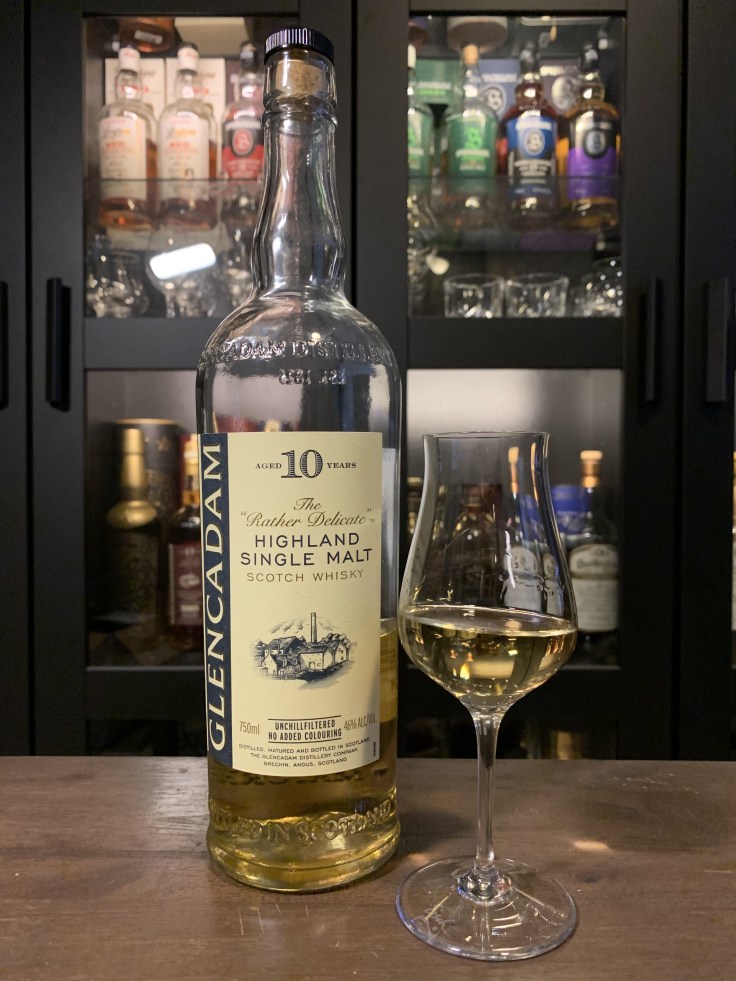
Glencadam 10 The Rather Delicate (2021)
46% ABV
Purchased: 2021
Price: $50 + tax
Aged: Presumed to be 100% bourbon casks
Score: 7. Very Good. Skip to the Review
What Does ‘Entry Level’ Even Mean?
For most things in life there is an entry point of understanding and skill. When embarking on a journey of learning, the general rule of thumb is to start out with something simple or ‘high level’. This applies to academic arenas as well as skill based endeavors. In math, you begin with learning to add and work your way up to differential equations and beyond. You should learn how to change the tires and the oil on your car before you replace a head gasket. For some things you can skip steps. It is not necessary to learn how to change a tire before tearing an engine apart, however you get to learn how to use some tools and see some basic elements of a car before you get in over your head. You may even encounter a problem doing something simple that can then be applied to a more complex task later on. Regardless, in almost all cases, there will be a recommended path towards more advanced topics that has been carefully tweaked and refined by experts or enthusiasts in a given field over a long period of time.
The general guideline for beginners is to start with something that is low ABV and will not scare them away by having “too much” flavor. Blended whiskies or lower age stated, 40-43% ABV single malts seem to be the go to in most cases, but I must seriously question this approach. It is true that many of the complexities of more robust and higher levels of integrity presentation may be lost on a beginner, and that the usual price jump may be a bit shocking to them if they are used to never paying more than $30 for a bottle of booze. That being said, I do not believe that flavor in and of itself should be shied away from. Additionally, how much of a difference is 40% ABV to 46% ABV in terms of “burn?” A new drinker is already going to find 40% high in terms of strength so why not give them the full experience of texture, sensations and flavors? Personally, I’d rather roll the dice with a new drinker by giving them some background on why the particular bottle/distillery is considered good, the history and show them the proper way to enjoy a glass of whisky, including adding some water if they feel it’s a little too much for them right off the bat.
What got me the most excited about whisky early in my journey was the culture, history and the deep dives into what made each bottle different. My desire to understand these aspects of an all natural drink whose main ingredients include time itself is what drove me to push through the burn or, at times, off putting flavors and sensations. I suppose it depends on what you are trying to accomplish in terms of wooing friends and family into sharing this drink with you on a regular basis. Are you looking for a drinking buddy or someone to sit with you and enjoy a dram and maybe a cigar? Or are you looking for someone to share your passion with? Either way is fine really, and I can empathize with both. The desire just to get your foot in the door with a potential whisky recruit may make you gun shy to dump the good stuff on them right away. I do feel that much can be gained by sharing your passion and knowledge and laying the seeds of curiosity amongst those that may just see bottles of whisky as they do bottles of vodka with different colored labels on the shelf.
The 2nd iteration of the Online Scotch Whisky Awards (www.oswa.co.uk) have just been announced by Roy of Aquavitae and Ralfy. This year Glencadam 10 was nominated for Best Value Whisky 2022 and I have to say that based on the description of the category it was well deserving.
“These are the fairly-priced whiskies that still offer great quality and help people take their first steps, yet still provide great value sipping for experienced drinkers. This is where we celebrate the whiskies that are still attainable, despite continually rising prices in whisky.”
I have come to find that the best way to meet the needs of both beginners and seasoned veterans is to combine accessible flavors with interesting sensations. Seasoned whisky drinkers can still enjoy the malty, fruity flavors of a lesser aged whisky, provided there is something there to keep them interested and sensations are a great way to achieve that without distracting the beginner who likely just hopes the liquid does not burn too much.
Review
Nose: A blast of fruit and dew covered grass. Lemon custard and fresh red apples. Freshly hewn oak with touches of cinnamon and nutmeg. With time in the glass the fresh red apples and spices meld into a mulled cider. Fresh baked pastries. Very pleasant and well integrated. Water brings out more fresh citrus and breadiness, but clouds the complexity severely.
Palate: Tart apples and cream on the front of the palate into an oak bitterness and sweet pastries. Well balanced, if not complex. Soft, but flavorful. Water leaves most of the palate intact, but tamps down the bitterness and leaves the dram feeling a bit more rich. Being that I find the sensations in this whisky the shining stars, this weakens the experience for me, however if you are more sensitive to bitterness, this may be helpful.
Finish: Barley sugar, chocolate powder, and a touch of ginger and/or black pepper. Sweet, but not overly cloying. I am a big fan of these flavors on finishes and my growing adoration for bourbon matured malts is influenced by this. Medium in length. Again, water leaves the finish largely as is but it feels shorter and a bit thinner.
Overall: This whisky has quickly shot up the ranks as one of my favorite “entry level” drams. I struggle to even call it entry level at times, as it only shows as young in the flavors and not the overall experience. This is a flavorful whisky and although the distillery’s description of The Rather Delicate is not inaccurate, there is enough complexity here to keep experienced whisky drinkers engaged. The complexity lies more in the sensations than in the overall flavor with sweetness, tartness, bitterness, pepperiness and maybe a few more ‘-nesses’ floating around in there. Thus far I have actually preferred this to the 15 year espresso. We will see if that holds up with some more direct scrutiny. Score: 7/10.
-
Review: Kilkerran 16 (2020) – The Chase
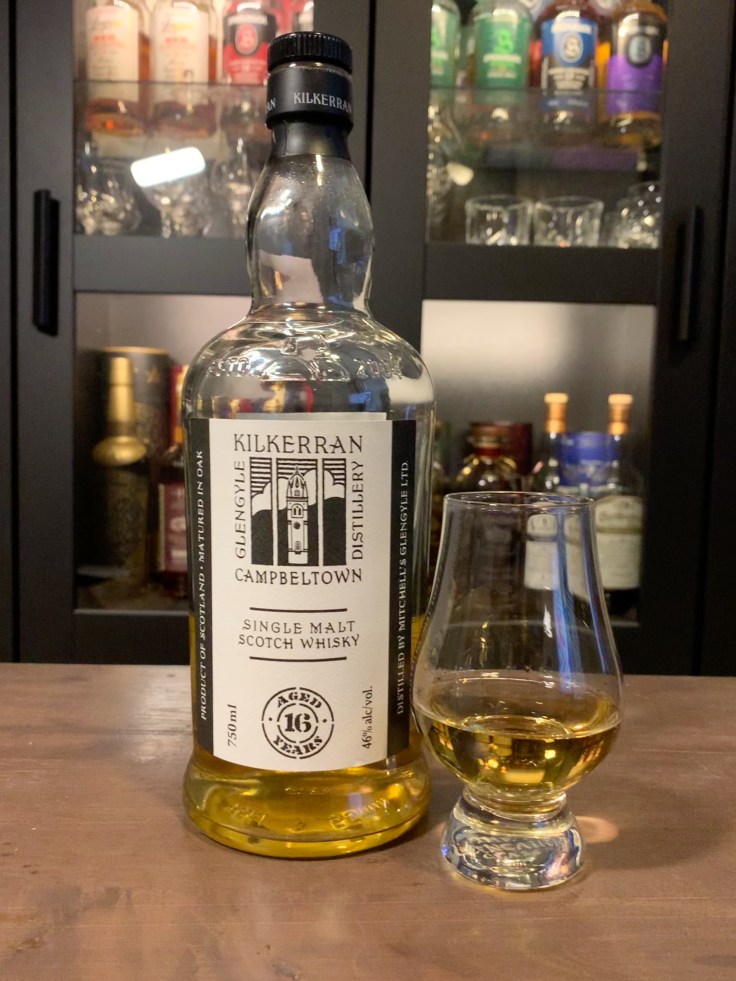
Review: Kilkerran 16 (05.10.2020)
46% ABV
Purchased: 2020
Price: $140 + tax
Aged: 96% Bourbon / 4% Marsala
Score: 7. Very Good. Skip to the Review
The Chase
I learned quickly in my whisky journey that I will not always be able to buy the bottles that I want. At the very least, I will not be able to buy the bottles that I want at the price I am supposed to be paying for them (according to the producers). Although I started my journey with bourbon and scotch in mind, the bourbon craze in the U.S. got me feeling all kinds of FOMO and I started hunting for those rare bottles pretty quickly and scotch fell to a distant second in my mind. I had no idea why I needed to find those bottles, as there were so many that I had yet to taste readily available on the shelves for reasonable prices. All I knew was that I really needed to try and find these so-called unicorns and post pictures to my local Facebook group.
I remember finding some bottles that I paid over MSRP for and subsequently feeling a little buyer’s remorse knowing that I had given into impulse and some unexplained desire. I had no idea what I was buying, never having tasted any of it. Looking back, I would happily pay those prices for those bottles now as the prices have continued to soar on the secondary markets to a point of laughability. Still, the absurdity of my FOMO and the obsession that had gripped me is not lost on me in the least bit.
Realistically, this whole idea of ‘chasing bottles’ is kind of absurd if you really take a step back and look at it from an objective standpoint. It seems to me that the emotions we feel from NOT being able to buy something that is made from simple and natural ingredients at a ‘fair’ price can be on par with being betrayed by a best friend. The amount of vitriol spewed at collectors, hoarders, secondary markets and social media influencers can be fairly shocking. Whisky is not the only hobby where one person’s boon is another’s bane, however it’s not simple envy that is at play here. It is actual spite. There’s more to explore here, which I will save for another day, but the point is that in an age with so many choices, we seem stuck on what we can’t have way too much of the time. I should say that there have been times when I managed to find a bottle of something hard to find and it was not elation or excitement that I felt. Rather, it was a relief that the bad feelings could subside…at least until the next release.
Funnily enough these feelings are what led me to discover my adoration of scotch whisky. I saw a post on a bourbon Facebook group that a store a few minutes down the road from me had gotten some Stagg Jr. bourbon in stock. Being that I worked from home and my calendar was clear of meetings, I jumped in my car and drove the 10 or so minutes down the road, taking time to curse every red light along the way. I got to the store only to be told the last bottle had just been sold. Dejected, I got back into the car to head home and that’s when it hit me. This is stupid. Why am I spending more time feeling bad about my hobby than I am being excited? The constant disappointment of not being at the right place at the right time, or not having spent enough money at one particular store really started to bother me. Before I had even gotten home, I had decided that I was done chasing bourbon and I was going to drink more scotch. I would buy bourbon if I found something I wanted but I was not going to beg and I was no longer going to feel bad about my hobby. The rest is history as they say and although my love of bourbon still exists today, I do not feel bad about missing out. Not to mention, once I stopped looking for it I actually had better success finding some of the rarer bottles. At any rate, the scotch community focuses on the broader landscape of what sits on the shelf and not just the ultra rare bottles that garner likes on social media. There is complaining to be sure, particularly around Springbank, and although I sympathize with my brothers and sisters in the U.K. and E.U., there are times I chuckle as the bourbon scene is much worse. Everything is allocated. All it takes is one positive review from a large channel and it will be a year before you ever see your favorite daily drinker on the shelf. Bottles do not just sell for 30% to 100% more than RRP but can be 5 to 10 times the retail price. Pappy Van Winkle is supposed to be $125 to $150 and sells for $2000 to $3000. It truly is stupid.
Kilkerran mania has not quite reached the lather that Springbank has, but it is close. I adore their 8 year old expressions and I even bought the latest releases from the auctions. I overpaid, yes. However, by the time they would have gotten to shelves in the States and the distributors and knowledgeable store owners took their cut, it really would not have been much more anyways. Plus, I didn’t have to sweat, hunt, or beg. No back alley deals on Facebook or driving all over town hoping to find what I want only to be disappointed. When the bottles arrived in the mail, I was content. The bottles will be open and drunk and shared. A slightly less difficult to find bottle is their 16 year old expression which I have jotted some amatuer notes about below. Just remember, if your hobby makes you feel negative feelings then it may be time to reevaluate.
Review
Nose: Primarily, I get fresh sawdust and candied pears. There is a sweet maltiness as well. This is accented by some Campbeltown funk in the form of dirty fresh mushrooms alongside some mild nuttiness and a slight coastal quality. Overall, the nose is more on the elegant side of the Campbeltown scale, if it has one. I enjoy it, but there is a part of me that wants it to be more Springbank, which is unfair. Water brings some damp hay to the forefront and tampers the sweet elements.
Palate: Caramel and vanilla upfront and the peat shows itself the longer you chew. The development blossoms into more Campbeltown style peat and mushrooms which contribute to a rich but dirty nougat flavor. The mild nuttiness from the nose is here as well. Water smoothes out the experience a bit, with a little less sweetness upfront, but the pears are able to come through. The peat on the development is more rounded. The whole experience has more of a silky mouthfeel to boot.
Finish: White pepper, toasted oak, and a barley sugar sweetness. Gentle peat lingers. Medium in length. Water adds a touch of a chalky texture, although I do not find it unpleasant. The finish is less peppery than when neat and the sweet barely is more evident. Overall, I would say it is more elegant, which given it is a Campbeltown, may be a detriment depending on what you are looking for.
Overall: The main criticism I have heard in regards to the Kilkerran 16 releases is that they do not match the 12 year expression in value and therefore are not worth a purchase. On one hand I can sympathize with that viewpoint, however, on the other I really do enjoy this whisky. I agree that it does not do enough to separate itself from a purely value proposition, but that does not mean it is the same whisky. Standing on its own I feel like this is a 7/10. I will do a review of the 12 year at some point and I feel like there is a good chance it will also receive a 7 or a strong 6. This makes the 2x price in the US a challenge for those shopping with budget in mind. It is a Campbeltown though and there is a premium especially with age for whiskies coming out of J&A Mitchell distilleries. Similar arguments are made with Springbank and their 10 and 15 year expressions. At the end of the day they are different experiences and if you are exploring $150+ 15-16 year old expressions, then you are looking for nuance and maybe some bragging rights to begin with. Additionally, due to the higher price points, they may be more likely to be available in your area. I am not disappointed with this purchase and picked up a 2021 version for drinking at a later date, at a higher price than I paid for this bottling as well. I am not going to punish this expression for its younger sibling’s excellence so I am going to stick with a 7. Score: 7/10. Very Good.
-
Review: Port Charlotte 10 (2020)
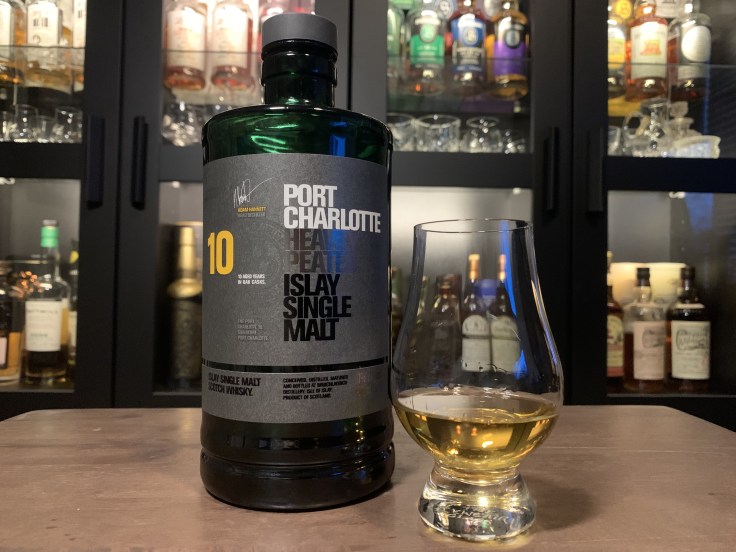
Bruichladdich Port Charlotte 10
50% ABV
Purchased: 2020
Price: $60 + tax
Aged: Oak casks
Score: 5. Average. Skip to the Review
A Whisky Heist
Bruichladdich has played an interesting part in my relatively short, but adventurous, whisky journey. Back in 2019 I had jumped into the bourbon and Scotch train full force in the autumn and began voraciously consuming whisky content on YouTube. My primary go to, like many beginners, was the Whiskey Vault/Tribe. Frankly, I couldn’t get enough and through them I had learned about a couple mythical bottles of Scotch from a distillery called Bruichladdich. One was described as the peatiest whisky in the world, and it was called Octomore. The other was a very mysterious and very expensive bottle known as Black Art, of which the 4.1 version (whatever that meant) was the most holiest of grails.
Fast forward a couple months to December when I traveled back home to Wisconsin to celebrate Christmas with my family. My girlfriend was coming with me, a Bay Area native, to experience her first Wisconsin winter. The state obliged, and snowed a bit and the coldest days of the year occurred during our visit. I was humored by the number of layers she put on just to go to the car and images from A Christmas Story popped into my head. You know the one, where Ralpy’s brother Randy tried walking to school without being able to put his arms down. On one of these trips, we headed to a large grocery store in town that had a substantial liquor store inside of it. I needed to get some beer and of course check out the whisky shelves to see if I could add to my fledgling collection. Lo and behold, in one of the small cases by the registers was not just a bottle of Octomore 10.1, but that holy grail, Black Art 4.1.
I gasped with dramatic flair. I don’t believe I had paid more than $100 for a bottle of booze yet, and frankly the idea of doing that still seemed absurd (Oh, how young we once were…). The Octomore was priced at $180 + tax and the Black Art was $380. I knew I wasn’t going to leave without the Octomore as it was described as being so very rare and so very PEATY. The Black Art however, was just not in the cards. I couldn’t do it as it just seemed like an insane amount of money. I can’t remember if I had watched Scotch: A Golden Dream yet where this bottle is featured alongside Jim McEwan and his journey with Bruickladdich. I believe I had, but regardless I told my girlfriend what I knew about the bottle and she must have seen the excitement in my eyes because she offered to buy it for my upcoming January birthday. Nope. Couldn’t let her do that. I mean, I could have bought it but I couldn’t justify it and it seemed equally absurd for her to do so. We left with my prize of Octomore in tow, still wondering how I got to the point of spending almost $200 on a single bottle of whisky.
I expected a big dose of buyer’s remorse to be honest. But it never came. We had flown from California so I wasn’t going to open the bottle until I got home, to my brother’s dismay. So it sat there in my old teenage bedroom in my parent’s house staring at me, and I stared back. I liked opening the tin and removing the bottle. It was like opening a secret compartment and seeing a pile of ill gotten gold and jewels. It just felt good. The jet black bottle was so smooth in my hands and it felt so weighty. I decidedly did not regret my purchase. I did, however, have regrets about not getting the bottle of Black Art. It haunted me as I knew it was sitting there just waiting for me, and only me, to come get it. My Precious. I started to scheme. To try and think of some way I could justify spending that much money AFTER I had already spent $200 on the Octomore. Finally, I found something of a workaround. I knew it was stupid because I hadn’t actually solved the original problem of ~$400 for a bottle of alcohol being ridiculous, but it seemed to calm my mind.
My girlfriend and I would split it.
She would pay for half as my birthday present, and I would pay the other half. I knew my brain better than anyone else and this was the perfect plan to trick it into doing what I wanted. Eventually we went back to the store for some more beer or food and I proposed my plan, and she rightfully seemed to have a look of “What’s wrong with you, just let me buy it…” painted across her face. But she thankfully acquiesced and we got the bottle out of the case and took it to the register, where……
It rang up for $300 instead of the $380 on display in the case! My plan had worked even better than expected and my brain could not argue any longer. There was no chance of regrets, as we had gotten a deal. “We practically stole it from them” I slyly told myself. So began a love affair with Bruichladdich. I still love it, although the lack of official bottlings with age statements over 10 years old is frustrating and suspicious. I finished that bottle of Octomore not that long ago, and replaced it with the 12.3 version and my bottle of Black Art is getting low. I’ll take this brief moment to send some praise to my girlfriend. She continues to support my hobby and passion and has carried on the tradition of buying me some rather nice bottles around Christmas/Birthday time. I no longer offer to pay for half though. Sometimes you just need to let folks be generous. 🙂

The Review
Nose: Smoke is present and generally ashy, but well integrated. Dominant note is coastal with a toasty edge around it. Digging deeper reveals some faint burnt popcorn and still-in-the-oven puff pastry. Sweetness is a bit lemon and malty which lifts up the coastal elements nicely. At one point, I picked out an almond biscotti with a lemon glaze. Water brings out the ashiness and pushes some of the sweeter and coastal notes more into the background. The citrus notes seem to turn more towards honey. Overall, it’s a full and well balanced nose. Very nice.
Palate: Oily. Arrival is fresh and briny with a lemon candy twist. This develops into a chardonnay like oakiness with a good dose of salty toffee and graham cracker. A gentle maltiness ties things together. It is coating and almost sticky in a pleasant, non-cloying way. Water brings out a thick dose of honey that is a nice contrast to the saltiness of the neat pour. It is, however, a bit more simple but not necessarily less enjoyable.
Finish: More salt and lightly oaky with a nice vanilla nougat and faint cocoa powder. There is a touch of minerality as well. Medium to long in length. Again, water accentuates a honey sweetness that does not overpower. There is an extra helping of cocoa powder as well.
Overall: This was a tough review to choose for my first public attempt. Not because PC10 is overly complex or difficult to interpret, but because this is a style that I have not been overly enthusiastic about for a while now. I enjoyed Port Charlotte 10 and can easily recommend it to any peat fans out there, but I personally don’t love it. It’s a solid bottle to be sure and at the end of the day I won’t complain about sipping on a glass of it. I don’t feel there are any natural flaws with it, I just feel it doesn’t commit to anything. It’s not a peat monster, it drinks a bit young and it’s also a bit one note with a salty citrus being the headliner and the other notes are mostly there to tie things together and round out the edges a bit. I also feel like my current palate isn’t totally digging the 10 year and under heavily peated Islay category right now, at least not without some wine influence. 5/10. Average.
-
Whisky Scoring Guide

Overall, I will be scoring a whisky on its quality and my personal enjoyment of it. A score of 5 is a legitimately average whisky, with no major flaws and one that is generally enjoyable to drink. A score of 1 will be extremely rare unless it is sought out purely because I know it is beyond terrible, which is unlikely. A perfect score of 10 is not impossible and I expect to have perfect scores given out eventually. Additional details will be listed below.
Reviews will include the year that I purchased the bottle and any batch or date information given. I will include the price I purchased it at (sans local sales tax, shipping, fees etc.), current pricing (or MSRP of a similar bottling) if significantly different that my purchase price, and potentially the auction pricing at the time of publishing if no reasonable equivalent is currently available. I may include value propositions within the review, however the score will not be affected. You may decide for yourself whether the price is worth the admission.
For a more detailed explanation of my scoring ethos, please read the following article:
Scoring Descriptions
1: Probably illegal
There is no reason that this poor of a product should ever exist in our lifetimes. I will try to verify that my bottle/sample have not been tainted in any way should I encounter something this poor.
2: Terrible
This is not something you want to drink. No redeeming qualities other than it contains alcohol which will help you on your personal journey to reevaluate your life choices.
3: Poor
Significant flaws that make drinking it neat difficult. The best use of these whiskies is likely mixed drinks or shooters.
4: Below Average
Drinkable neat but with some obvious flaws. Not necessarily bad, but falls short of today’s market standards.
5: Average
Good and enjoyable overall. No major flaws nor anything extraordinary happening in the glass. I’m happy to drink these neat.
6: Above Average
Brings something more interesting to the table such as clear and interesting distillery character, clear but balanced cask influence, or something just to grab onto and enjoy. Definitely worth exploring.
7: Very Good
Now we are talking. This is starting to get exciting and I am looking forward to having more. Complexity is emerging beyond simple distillery character and cask influence. Time, environment, cask management and masterful blending are starting to take shape.
8: Excellent
I am starting to become conflicted on whether I want to share this with the world or hoard it for myself. This is good enough to make me stop and just be happy about my choice of hobby and that I was lucky enough to stumble onto this passion.
9: Wow
Liquid to be treasured and an experience to tell stories about for years to come. This is a whisky that deserves to be celebrated. A wonder in and of itself.
10: Stunning
Upon first sip, the world stops for a moment. No tasting notes. No critique. Time is now irrelevant, as there is only flavor. This whisky cannot be drunk standing up and tissues should be ready for the inevitable tears. An actual milestone in human achievement.
-
Scoring Whisky: Simple or Quantum Mechanics?

Scoring whisky is an interesting topic to me and it seems to be a bit of a controversial one amongst the community. In reality, most topics/hobbies that introduce a scoring system to rate one product against another have similar and maybe more extreme issues. In the video game industry, for instance, there are strong fandoms that refuse to accept that the latest installment in their favorite franchise could be anything other than a perfect 10/10 or 100/100. A reviewer that does not agree can be bombarded with social media vitriol and have their YouTube comments filled with angry trolls, fanboys, and maybe even the game developers themselves. Context is rarely taken into account, as if you were to read the article or watch their video in detail you would clearly see that there are objective flaws with the game or that the game systems, genre or story motif do not strike a chord with the reviewer and thus a 7/10 or 82/100 is a valid score from their perspective. This is of use to their community if you assume that they have built their community around a common love of similar games.
Equally, crowdsourced reviews via sites like www.metacritic.com or game distribution platforms like Steam can be used to punish developers and publishers for business related decisions (releasing a game before it is done, greedy monetization schemes) or poor corporate behavior (ill-treatment of employees, etc.). Large groups of people, some not even interested in ever playing the specific game, will “review bomb” these sites by giving the game a 0/10 and drag the overall score down, inevitably slowing sales and causing the media to pay attention and, at times, stock prices to fluctuate. I am not here to support or criticize these tactics, only to point out that subjective scoring is a volatile and often politicized tool that people can take advantage of to either get a message across that may very well need to be heard, or to advance an agenda or an opinion that may or may not be relevant to the actual subject of the review.
I have not seen too much of this in my time lurking in the whisky-sphere although there will always be folks who disagree with certain scores and they may have valid points, assuming they give a constructive reply as to why they don’t feel the review is fair. The primary crowdsourced review site, www.whiskybase.com, is generally filled with subjective reviews that are useful to fellow readers to varying degrees. There are certainly biases towards styles, regions, distilleries, presentation, pricing and many more. However, these biases are usually framed in context and are understandable. We all have our favorites afterall, and I am no different.
I am biased. It’s impossible not to be.
There are going to be whiskies that I want to like, those I am curious to see if I like, and those that I expect I will not. I cannot think of any that I do not want to like, but I am not going to recuse myself from that level of bias just yet. I am still fairly new to this after all. I suppose if I sat down to review a bottle of Johnny Walker Red and it turned out to be the one true nectar of the gods, manna incarnate, I would hesitate. Maybe that means I do not want to like Johnny Walker Red because giving it a perfect score would delegitimize me in the eyes of anyone who reads my blog. I would be stuck between being honest and just writing a review that nobody would think twice about and move on while enjoying the spoils of my new found bounty, unless of course I outlined what made me love it so much and the reader took the time to try and understand. Maybe I’d even change a mind or two…
Anyways, there seem to be two schools of thought for scoring whisky. The 1 to 100 scoring system and the 1-10 scoring system. There are going to be different ways to interpret these rating systems, but there does seem to be some correlation as to how they are used across outlets. Here is how I generally interpret these systems, and I do mean a completely personal interpretation:
1 to 100
- “Good” whisky seems to be scored at an 80 or above.
- Below 80 is a definite “Avoid”
- 90+ is a treat and something you should absolutely seek out.
- Nothing but undrinkable swill will score below 70.
- 100 is unobtainable
- More granularity is allowed. Reviewers openly struggle with bumping up a score from 88 to 89, 91 to 92, etc..
- Recency bias and nostalgia come into play within the granularity in direct comparisons to recent reviews or a long gone beloved bottle.
- This is meant to compare bottle to bottle, at least from a reader perspective. If bumping a score up one point is a major increase in quality of experience, which many reviewers seem to emphasize, then it must be worth buying that over something one point less.
- There seems to be an exponential increase in quality for points above 90. A bottle that is an 80 is still in the general ballpark of quality as something that gets an 85. However, a bottle that scores a 95 is a massive increase in quality over a bottle that scores a 90. In other words, every point closer to 100 is worth more than the last. Additionally, it feels like going from an 89 to a 90 is more difficult than an 88 to an 89, again creating an inequality between points.
1 to 10
- This results in more of a ‘categorization’ of whisky which puts bottlings into groups of relative quality.
- Limits bias towards style/region/etc. Broader categories of scores catch and eliminate or filter some degree of bias if you are not agonizing over giving nuanced scores.
- Scoring a 5 is a truly average whisky of acceptable quality.
- A perfect 10 is rare but possible because there is no risk of one day having something “better.”
- A score of 1 is probably less likely than a 10 in the modern era, if not impossible.
- There is still agonizing over bumping up points, but it makes more sense to waver as increases are more meaningful to recommendations of buying that whisky from the reviewer.
- Reviews may be somewhat less impactful in purchasing decisions. It’s possible a reader already knows some options are good, but wants to know what is better and if they all fall in the same ‘category’ they may have to move on to other reviews for more granular scoring. Contect in the written review should be enough to decide, but not everyone reads the reviews.
I have chosen to use the 10 point system. Trying to find the level of granularity to provide accurate X/100 reviews feels too difficult for me at this point in my journey. My reference points are simply too small, even if I have had 100s of different whiskies of various styles at this point. I also feel that the categorization of whisky into X/10 scores more accurately represents what whisky is. It changes through the bottle, from night to night, from glass style to glass style, etc.. It is a more accurate representation of how I feel about a particular bottle. I feel it also allows me to more confidently place samples that I may review in relative position to whiskies of similar quality without drinking an entire bottle.
Pricing
The next big topic is whether or not the cost of the whisky should factor into the score. This seems to be a dividing line in the review world. In all honesty, I was absolutely prepared to include pricing into my scoring, however once I decided to use the 10 point scale, I started thinking about it and I could only think of reasons to not include it, provided that I incorporate the general price I paid and a comment in the review.
Here are the reasons I am choosing to not include pricing into my scores, but rather to include value in the context of my reviews. Generally, this is specific to using the 10 point scale as the granularity of the 100 point scale makes some of these points irrelevant.
- It seems like you inevitably set limits for pricing on whisky. No 8/10 can ever cost more than $200 for example. It just feels wrong to draw a line in the sand. If you don’t do this then you are still using the 100 point scale in a sense. “It was a poor value but it was a high 7 so I won’t dock it a point.”
- Not being worth it is relative. $20 too much, $50 too much, $100 too much? How much do you punish a whisky, especially when a price increase goes into effect? Punishing something relative to its previous price seems natural, but so is inflation. How do you factor in the general trend of increasing prices across an entire industry? Prices go up, and yes, they are going up considerably faster than normal in 2022. I can see rewarding a distillery for not raising prices, but especially in the US the distillery does not have control over the network of distributors who can charge what they want and reward certain stores based on volume, etc.. You are throwing a dart at a moving board.
- This feels like an inevitable sliding scale/fibonacci sequence type scenario. A $50 to $70 increase feels different than a $200 to $220 increase. Do you punish/reward the same? Probably not, but in the wider view of the whisky landscape it seems like this can get muddled quickly. Additionally, previous reviews can become irrelevant even faster than they would otherwise.
- Consider that Whisky A is $50 and Whisky B is $200, both of similar styles. Whisky B is clearly much better than A, but A is still high quality. Whisky B is generally not $150 (4x) better in the eyes of the reviewer. Whisky A is a 6 for Quality, but is a great value so it’s given a 7. Whisky B is an 8, but is not a value (it crossed the price threshold), so it’s given a 7 or maybe lower. The impression is that these whiskies are equal in some way, but they are not. Whisky B is being punished for A’s reward as they are tacitly being compared and this results in something resembling a zero sum game.
- It is known that there are diminishing returns for pricing in whisky as with most things in life. It comes down to flavor chase over time, finding something unique, prestige, rarity, etc.. A $1000 bottle is not 10 times “better” than a $100 bottle. But that’s not why people buy $1000 whisky. Vintage whisky is a good example. Is a 1972 Brora or an old Macallan worth what they go for in auctions based on flavor? Probably not. Are you giving them a 4/10 even though they may be considered some of the best whisky to ever exist (yes, reviews on these whiskies are exceedingly rare, so this may be a bad example)? I tried the 37 year Brora release and it almost made me cry. It is on the shelf in the US for $2300 I believe. Frankly, it’s worth it. I just can’t justify buying a bottle. I can’t punish it for not being a “value” even though it’s probably the best thing I have ever tasted.
- Value is as subjective as taste, if not more so. Most of us have biologically similar taste buds excluding the super taster or specific sensitivities which are easily identifiable (sulfur) and communicable to a reader, but our bank accounts are very different. Experiences are more disparate when it comes to taste based on culture, means, etc.. Assigning a score based on taste is difficult enough and highly subjective. Adding pricing into the score equation makes the score feel like something that is approaching random based on a large number of variables that are not transparent to the reader. Reviewers are not posting salaries and stock portfolios alongside their reviews so their definition of value is somewhat of a question mark to a random reader. “I can’t afford it” is not the same as “It’s not good value” (see my comment about the Brora). Readers ultimately have to trust that the reviewer is able to see value from their viewpoint and there is no direct evidence that is ever going to be true.
- Lowering the score of a whisky from an 8 to a 7 based on value would be the same as lowering it 10 points in the 1 to 100 scale, which does not happen in my experience. Using value to bump up or lower a score in the 100 point scale is easier and makes more sense as you have more control over the dial. Dropping a whisky 10 points in that scale would, again, equate it to whiskies that are clearly inferior in quality which does not seem right and therefore shouldn’t happen in a 10 point scale.
- Why is simply posting the MSRP, RRP, or current auction prices in the review and allowing the reader to decide if they want to spend that much money on a X/10 whisky with a given set of tasting notes not sufficient? Who am I to decide if something is worth it for YOU? I can say it isn’t worth the price to ME in my review which is my perspective taking everything above into account. You can take that for what it is based on your situation.
I will provide additional scoring metrics in another, more succinct post, but for now I feel that the best option for me is to use a 10 point scale that does not factor in price. I will do some research to see what the going rates are around the world and give my two cents in the review in regards to overall value. I am open to dissent however, so please feel free to leave any feedback in the comments or on social media. I would be happy to engage further in this discussion as I feel it is important to get this right in the long term.
-
My Journey – How I Got Here
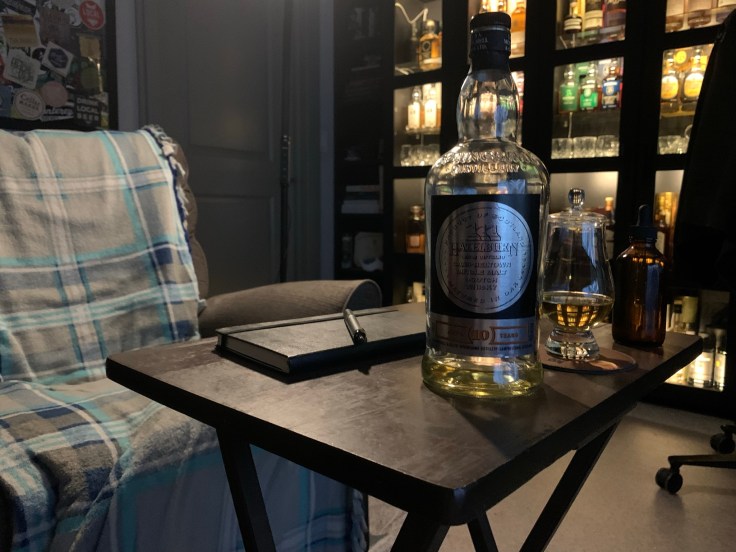
How did we come to this? Me, sitting here in my office, surrounded by a whisky collection that has exploded over the last 2+ years of a worldwide pandemic. Now clumsily, and fairly haphazardly, starting up a whisky blog. It’s a question that I kind of know the answer to in my gut, but pretending that I have any degree of confidence in that answer would be a foolish exercise that anyone that knows me would see through in an instant.
In all honesty, there is an urge to minimizing what I am doing.
“Nobody will ever see this.”
“I’ll probably give it up in a month.”
These things are certainly possible, and maybe even likely. Yet there is a calling to try and put my thoughts and opinions down on paper. This whole whisky thing has all been a whirlwind. An obsession that took over and has led me down a path of smells, flavors, opinions, blogs, YouTube channels, blind flights, new friends, a depleted bank account, and new global perspectives. I guess I am wise enough to know that I know nothing, but I have that calling to try and sort out everything I have experienced and learned over the last few years and this seemed like the only reasonable route. The story seems kind of boring to me as well, maybe because I was there, or maybe because the story really is boring. But here goes nothing…
I grew up in Wisconsin, in a medium size town right between Milwaukee and Chicago. For those of you unfamiliar with the various cultures found in every individual state in the US, Wisconsin is known for being fond of its alcohol and cheese. Lots of cheese. I am not going to dive into a history lesson here, but Wisconsin was a center of US beer production at one time, with Miller being the big boy on the block that still has a large presence throughout the state. Wisconsin’s cold winters and short, but hot and humid, summers contribute to alcohol being used both to fight off boredom during the winter and to celebrate just being outside and seeing the sun in the summer. Hence, quantity over quality is a driving force behind the consumption of alcohol. Somebody is always handing you a beer, which makes the proliferation of the American Light Lager somewhat understandable. It’s hard to drink all day if your beer isn’t under 5% ABV.
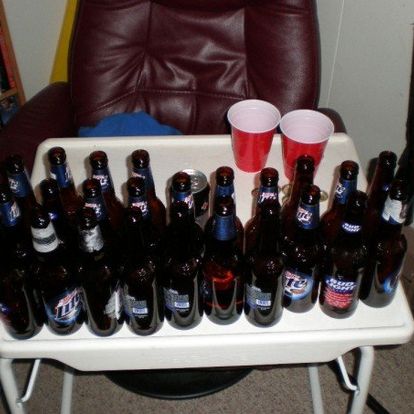
High proof spirits had a different role to play. Yes, they were used to mix up tasty cocktails like Brandy Old Fashioneds, the State’s claim to fame in the cocktail world. You could order these “sweet” which meant a splash of 7-Up or “sour” which meant a splash of Squirt. But as beer dominated the culture, spirits were mostly drunk as shots to really ramp things up later in the evening, or more sadly, the realm of the sots who couldn’t get what they were looking for from cheap beer anymore. This applied mostly to the men, as women were free to order whatever mixed drinks they liked, but as big, strong, manly men, we drank beer and took shots and that was usually whiskey. If the girls were involved, you could get away with a lemon drop or tequila shooter, but if it was just the boys a round of whiskey it was. You could choose from the rail whiskey, truly terrible swill that had labels you had never seen before, or if you had a few extra bucks in your pocket you could go for Jack, Jim, or “Jamo”. I usually went for the Jameson. It had an air of quality to it, being imported, and it just went down easier.
Primarily, my journey with booze started when I went to college at the University of Wisconsin – Madison. A very good school, known for its party culture which resulted in it often being ranked #1 by Playboy magazine for that debauchery until they retired the school from the ranking because it won nearly every year. At least that’s the story I heard anyways. Surprisingly, during my time at UW, I had my first awakening to the world of “quality” alcohol. The craft beer scene was burgeoning around the US and a brewery in Wisconsin was quickly gaining steam, New Glarus. Their Spotted Cow cream ale was sweeping across the state. It still tasted like “beer” unlike the IPAs coming out of California, but it was…good? Like…”wow, this is what beer tastes like?” good. A competitor was Blue Moon, a Belgian White Ale that came from Colorado and is owned by Coors. Those were hazy and came with an orange slice which made them a little foreign, and the Wisconsin brewery was closer to home and was frankly considerably better.
This gave us the go ahead to try some other beers and, for me, it was Guinness that stood out. There was a bar on campus where on Tuesday nights you could get a pint of Guinness for $2. It was probably stale and we joked it might have fallen out of the back of a truck, but we liked it and would “impress” random people by chugging the entire pint in a race to see who was cooler. Spirits, however, were still the realm of getting drunk and doing it quickly. As our tolerances rose, we would drink more of them in various ways with the more liberal campus culture allowing for some exploration into exotic martinis, tiki drinks and discounted mixed drinks for a couple bucks on certain nights of the week at various bars.They were all still bad though, looking back, with the sugar contents masking the cheap ingredients therein.
Post college, there was a bit of a return to the standard Wisconsin drinking culture I mentioned previously, with the exception of Spotted Cow now being a standard everywhere and most bars would proudly advertise “Spotted Cow Sold Here.” I had moved back to my hometown with no real direction on what I wanted to do with my barely earned degree while staring at a mountain of debt. The alcohol helped as a distraction and a reason to get out and not think about the creditor phone calls rolling in daily. Finally, I found a decent job in IT based on my interest in computers and I started digging out of the hole I had created. This also exposed me to some people outside of my normal group and eventually I wound up going to bars with them in towns that were not mine and was introduced to some more quality drinks. I remember Hacker Pschorr being one of the beers (this came with a lemon!) and it was a huge step up from the Blue Moon I knew from college, and I believe I was introduced to Patron as a tequila, not knowing there was another tequila other than Jose Cuervo.
It may be a good time to pause and talk about what I realize now after so many years of slowly building up to my current relationship with alcohol. What is evident today are these “eyebrows up” moments. Moments of realization that there was more out there. That my world was too small and that I had in some ways wasted time, money and liver cells on inferior drinks. Keep in mind that drinking alcohol was still something that was just supposed to be inherent to my existence based on where I lived and who I generally hung out with. I know this doesn’t make me special, but it was something that just seemed destined. People drank booze. People got drunk. It was normal and unless it got out of hand no one was going to judge or bat an eye. It would be more shocking if I didn’t. This seemed to make these moments of awakening more acute as they truly affected my outlook on my life. They threatened to alienate my friends and even extended family to some degree. Simply not drinking the cheap light beer and barely passable whisky would make me look like I thought I was better than them and that I had lost touch. Another realization I had during these times was that once you know the truth, it’s really hard to go back. Once I had Spotted Cow I did not know how I was ever going to enjoy a Miller Lite again, and I knew in my heart that there was no going back. It’s the same with food and cars and so many other things. You get a taste of the good stuff and everything else seems a little more bland. You can taste the added sodium. You notice the slower acceleration. Your department store shirts don’t fit quite as comfortably. It nags at you, always in the back of your mind. You know it could be better.
Back to The Journey. Things only accelerated from here. I got promoted at work and before I knew it, I was traveling on behalf of my company. At first it was mostly up to Canada. We started going out to nicer restaurants, and some of the older coworkers would order wine and specialty spirits that the company would usually pay for. I was in a phase of just trying new beers as I came across them. I didn’t really know anything about them, I just knew I like trying different things at this point. Some were good, some not so much. I would occasionally accept an offer of a glass of my colleague’s red wine and generally enjoyed it, but I was more focused on my growing interest in beer. Wine was too posh. I could get away with being snobby about beer as long as I accepted whatever beer my friends tossed me without grimacing, but wine was a world I was not prepared to enter lest my social life back home collapse around me. Regardless, I was being introduced to new foods and drinks, and I had a little money in my pocket. A far cry from a few years earlier where I was selling belongings to go out for some cheap drinks with my friends.
I should mention that during all of this, I would occasionally buy myself a bottle of “nice” alcohol or order something more expensive at a bar. You see, I liked the idea of drinking high end spirits at this stage (high end being $40 a bottle at the time). However, I rarely found myself actually enjoying them. I didn’t get it, at least not like beer. I would usually just revert to mixing them into drinks or letting others drink them up and say they were living the high life at the party we were at. I now know that most of those were only “high end” because the marketing department said so, and I didn’t know how to drink them properly anyways. My cocktail making skills were non-existent and if it wasn’t making a terrible martini, I just did what I saw in the movies: pour into a tumbler and drink.
We wrapped up our work in Canada and the next target was Australia. We were deploying software and training employees on how to run their businesses on the new application. This is where I met Russell who traveled from California. He took me to a Belgian beer bar and introduced me to sour beers which, at the time, I absolutely loved. He also talked about IPAs and other craft breweries which intrigued me. Coinciding with this discovery, an Australian colleague of mine who I spent a lot of time with over my 7 straight weeks there introduced me to his favorite scotches. I knew the word “scotch” and that it was whisky, but I didn’t know what specifically made something a scotch. I had previously ordered a Macallan 12 at some point in a bar that my friend’s brother worked at because he insisted it was one of the best whiskies in the world. I hated it. I also think I ordered shots of Johnnie Walker Black at a bar at some point because they were on special, which I immediately determined was a mistake. My Aussie colleague, Robin, first ordered us a Talisker 10 year and upon bringing the glass up to my nose I was intrigued. What the hell? Why does it smell like a campfire? Still I reached down into my manhood and took a sip. I am not going to say that I liked it, but there was something there. It was interesting. Harsh and burn-y, yet alluring. I declared that it was good and made my way through the dram. Another American co-worker agreed although I do not know if he was telling the truth. At this point Robin announced that if we thought that was good, then we needed to try another scotch whisky, which was his favorite: Lagavulin 16. I honestly don’t recall if I liked the Laga better than the Talisker, or if I could even tell the difference, but the Lagavulin name stuck with me.
A couple years later, our travels sent us to the UK. I was spending a couple weeks at a time driving around England learning how to drive on the wrong side of the car, on the wrong side of the road. That company sure did have faith in me. I only hit a few curbs and after a few two week long trips I was swearing at people for not knowing how to drive. Bloody idiots. At some point I was staying in a small town in the north of England running one of our deployment and training sessions. My aforementioned coworker Russell was doing the same up in Edinburgh. We had a few days between classes and decided to meet up in Glasgow for a long weekend. We made the decision early on that if we were going to be in Scotland, we had better drink some scotch. I believe we asked the folks at the hotel about local whisky bars, and we were directed towards a pub called The Pot Still which was within walking distance of our hotel.
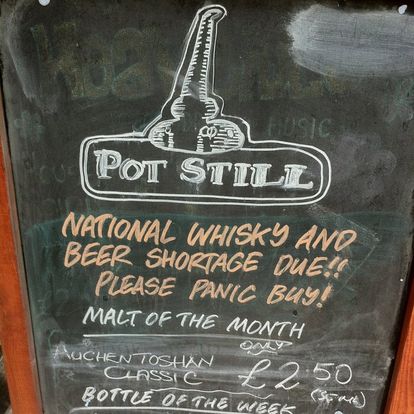
Upon entering The Pot Still, we were greeted with a wall of whisky. 500+ bottles of Scotch and other assorted golden goodness. It was beautiful, even though neither of us really knew what we were looking at. After clumsily asking the bartender for recommendations, we went back to an open table and began exploring our whisky. I do not remember what drams we had while we were there. I do not even really remember if I enjoyed the whiskies. I do remember getting pulled into a trivia night and having the bar erupt into cheers if us two Americans actually managed to get a UK/EU related question correct. We had a blast and I will always remember that day. The rest of the short trip went about as well and I ended up coming home with a few bottles of Scotch. I still didn’t know if I liked it, but I was certainly caught up in that pesky idea that I wanted to like it. I remember the bottles I came home with relatively well. All were recommended by shop owners or bartenders. A Hart Brothers Mortlach 14 year, a fairly early batch of Aberlour A’Bunadh, the aforementioned Talisker 10 year and an early release of Kilchoman Machir Bay. An eclectic selection if I may say so myself, if not beginner friendly. I also bought a bottle of Lagavulin 16 once I returned to the States. Notice I also loosed up on the wine stance while in Australia and being introduced to Shiraz.
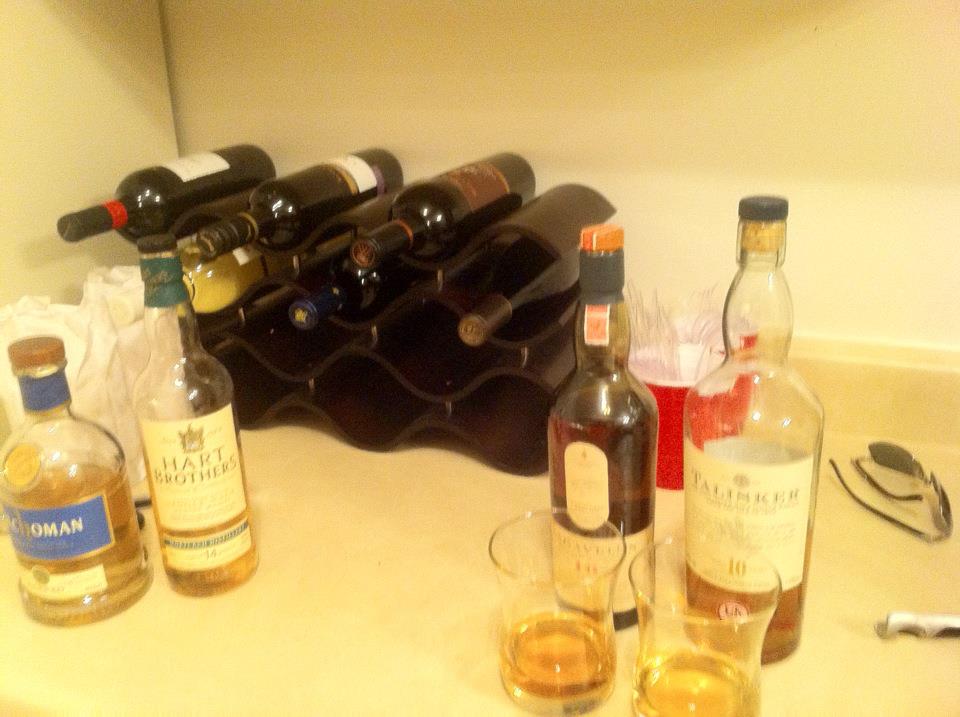
Unfortunately, these whiskies again fell on deaf ears, I assume to the sincere chagrin of many whisky enthusiasts out there. I just couldn’t get into them. Again, I moved on both figuratively and literally. In fact, most of these bottles were left partially full with my brother when I moved across the country to the West Coast. I was California bound, looking for that “more” I had come to desire so deeply. That need that lurked deep down. There was more out there, and I was going to find it.
By the time I arrived in California in 2014, I was a full blown craft beer enthusiast. I wouldn’t call myself a nerd nor a geek, because I frankly didn’t care how the beer was made, or what flavor notes particular strains of hops imparted. I just like trying new beers and marveled at the range of flavors and styles you could experience. My understanding of what beer was and could taste like had expanded massively and I couldn’t get enough. I won’t dwell on this too much other than to reiterate I was hooked on flavor, and through Facebook, I was able to find some like minded people who became friends, giving me my first taste of community around a hobby that I had struggled to convert friends to for years.
Let’s finally get into the meat of this tale. You see, I moved to California without a job. I had quit a stable, long time job in Wisconsin, the same one that had taken me all over the world, and just said I would figure it out. I did, getting a job about a month after arriving through a former colleague. I was hired as a contractor but about three months later they converted me to full time and I was going to celebrate as my gamble had paid off. I went to the local BevMo and my desire to like whisky brought me to the scotch section, specifically the glass case. I perused their offerings and I went past the Glenfiddichs and Glenlivets which I knew were “cheaper” brands. I saw a few I had never heard of and then my eyes fell on something familiar. A bottle of Macallan 18, priced around $225 if my memory serves. I knew the brand, and I thought back to that glass of Macallan 12 that I didn’t like very much a few years back. It was supposed to be an amazing whisky, unlike those “budget” brands. I decided that I was the problem and I needed to get this bottle to prove myself wrong. Plus, it would look good when I posted a picture to social media.
Upon arriving home I went out on the balcony with my prize and a tumbler and poured a glass, snapped a photo, and posted to Facebook about my accomplishment. Upon first sip I realized that I still did not get it. It just tasted like whisky and another disappointment, this time one that cost me over $200. I powered through however as I was not going to admit to anyone that I did not like it. One thing I had realized at this point is that the one thing I liked less than a neat pour of whisky was a pour of whisky over ice. I truly despised cold, watered down scotch and honestly, that hasn’t changed much. I am not sure how long it took to finish that bottle but it was certainly a couple years. I was gifted a bottle of Balvenie 21 Portwood, which here in the US is bottled at 43%, for Christmas one year from my brother around this time. I like that one better than the Macallan but still didn’t fully connect with it.
Throughout all of this I must have given off the impression that I was into whisky. I was gifted the aforementioned bottle of Balvenie and soon thereafter my boss began giving me bottles for Christmas gifts. I distinctly remember him giving me a bottle of Stranahan’s American Single Malt whisky and said “You’re a whisky guy right? You’ll like this one.” Uh yeah…sure. I get home and decide to open the bottle up and have a taste.
Boom.
Liquid caramel in a glass and absolutely delicious.I had done it. Finally, I had found a bottle of whisky that I enjoyed drinking and it did not take all that long for me to finish the bottle. I promptly went out and bought another. He also gifted me a bottle of E.H. Taylor Straight Rye the next year which I enjoyed as well and went out to buy a bottle of that. I found one and bought it, and I have not seen another bottle on a shelf since. The hits kept coming when I left for another company and went to a team Christmas party where I was introduced to Hibiki Harmony, a Japanese whisky which I do not believe I was aware existed prior to that evening. I went out to the store that weekend and found myself a bottle. I remember asking the store owner for the Hibiki and he said “I assume the Harmony?” Looking down I saw a bottle of the 17 year old and noticed the price tag. I sheepishly answered “Yes, the Harmony.” Still, I had a whisky collection going. I set up my half dozen or so bottles on a little cabinet I had in my home office and busted out the whisky glasses my mom had gifted me at some point and set them up alongside my bottles. Again, people thought I loved whisky at this point and I am not sure why. I was, however, starting to learn and it was fun. I was enjoying my whisky although I was only pouring a glass or two a week and still not anywhere near where I am now in terms of understanding and enjoyment.
That changed one night as I was sitting at my computer watching YouTube. I am not sure how I came across them, but I found a series of videos featuring The Whiskey Tribe and Modern Rogue describing how to enjoy whisky. They went over how to read bottle labels, the differences between scotch and bourbon, how to smell and taste, etc.. I was enthralled. I immediately started watching more of their videos and wrote down different whiskies that they and the community recommended. I took my list and headed out to Total Wine and found a handful of their recommendations and brought them home.
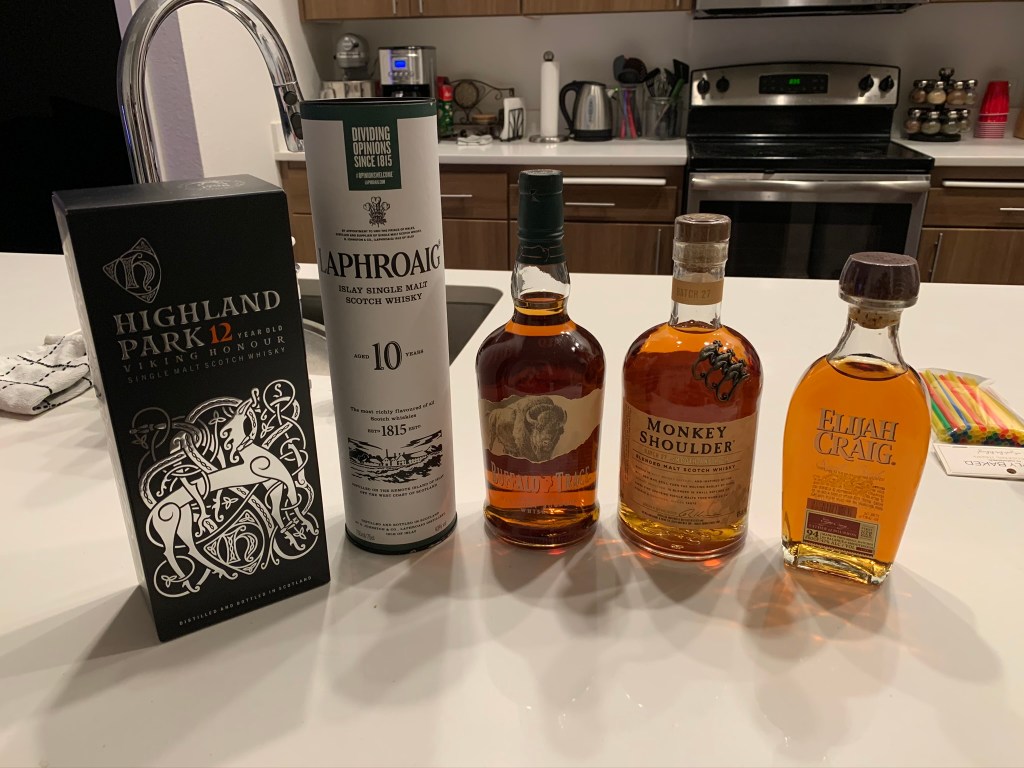
I was hooked and there was no looking back. However, a mere 6 months later the world changed seemingly in an instant. My collection had been slowly expanding and I had joined a local whisky Facebook group, although I hadn’t gotten the chance to meet anyone in person yet, and COVID made sure that wasn’t going to happen any time soon. And so, I was alone in my journey once again. Or was I? YouTube, Facebook, online tastings, Reddit, blogs, review sites…I wasn’t alone after all. It also didn’t take long for liquor stores to be considered ‘essential’ in California and I had an excuse to go outside. I could leave my apartment, get in my car and drive around to local liquor stores and not be cooped up all day. Of course, my collection began to grow quickly once that started up and I had plenty of free time at home to indulge my new passion and an unending supply of online content to consume.
At this stage, the bourbon craze had swept me up and I was experiencing all the intense FOMO that has become synonomous with being a whisky enthusiast. I had never tried these rare and expensive whiskies, but holy crap did I want to. I managed to find a few in my travels, but I probably was not ready to fully appreciate them. I told myself I loved them, however that was almost certainly my brain convincing itself that was the case. I was learning though, and I was truly enjoying the process. Eventually after moving to Colorado, I realized that chasing bourbon was just not fun. I was disappointed too often and the negative feelings I was experiencing were just not worth it. I made a decision after missing out on a bottle of Stagg Jr. that I was going to focus on scotch and if I found good bourbon along the way, then great. I quickly fell in head over heels and have not really looked back. I still love my American whiskies, but scotch is my baby. When asked if I prefer bourbon or scotch (a completely unfair comparison given bourbon’s restrictions in manufacturing) I tend to say that bourbon is my comfort food and scotch is my Michelin Star restaurant.
I was now enjoying whisky more than anything I had gotten into in a long time. Maybe ever. I wanted to know how whisky was made, I wanted to know the differences between styles and distilleries, and I wanted to know about the people who made it. I never cared about that stuff w
hen it came to my craft beer obsession, which had raged unabated over the 6 years I spent in California. I now realize that not only did I love tasting new things and discovering flavors, but I liked the friends and characters I met along the way as well. But whisky was more than that. I always knew I wanted to love it, and my repeated disappointments were brutal. But for whatever reason I never gave up. At times I have wondered if I made whisky in a past life or something. Nothing has grabbed me quite like the wide and wonderful world of scotch, bourbon, rye, Irish and all the amazing world whiskies that are out there to discover. The history, diversity, community, characters, politics, and the booms and busts just make for a story Hollywood could never invent.
Whisky is also art. The bottles, the (often ridiculous) packaging, the carefully and romantically written (and equally ridiculous) marketing blurbs, and of course the liquid in all its glorious shades of ambers, golds, reds, and browns. Whisky is also an amalgamation of the most intense characteristics of humanity. Beautiful, ridiculous, and capable of destruction if not given the proper respect. It’s all natural, but often tampered with to appeal to the widest audience. Cosmetically enhanced based on social constructs and what some think the rest of us want. It goes through good times and bad, is loved and then neglected, and the longer you leave it in an environment of positive influence the more it matures into something amazing. Maybe that’s why we love it so much and why rebellions and trade wars have been fought over it. Whisky is us in so many ways. One of our greatest inventions all derived from the Earth and its bounties. It sings to us, it binds us and it makes our stories so much more interesting. We romanticize those who make it and have created heroes out of the outlaws that kept it alive.
My story continues here in Colorado where I am running out of space for more whisky but I have some friends to share it with now that COVID has loosened its iron grip. I need to talk about it and to put my journey out there to some degree. I am too excited about where this has taken me and where I know I have yet to go. I can’t get enough and frankly do not want to. It took 36 years to find my passion, but I found it and I need to share it. Now approaching 40, I decided I couldn’t wait any longer to “know what I am talking about.” So educate me. Let’s chat.
-
Subscribe
Subscribed
Have a WordPress.com account? Log in now.

